
Pearl City Directory Collections by Era
The Pearl City historical shelf is not one local title. Publishers indexed Honolulu, the territory, the City and County of Honolulu, or wider Oʻahu. Pearl City names must be isolated with the street guide, personal-name index, classified business pages, and terms such as Manana, Waiawa, Waiau, Lehua, and Pearl City.
| Collection | Years | Where held | Access |
|---|---|---|---|
| Bennett, Bowser, McKenney, early Hawaiian titles | 1869, 1871, 1880–81, 1884 | HSA, UH, catalogs and digitized copies | Catalog, reading room, selected web images |
| Husted and related runs | 1886–92, 1898/99, 1900/01 | HSL, HSA, UH | Print, reference, selected digital copies |
| Polk-Husted Honolulu/Oʻahu | 1902–1942, subject to shelf gaps | HSL print/microfilm, HSA, UH | Microfilm S51152, print, selected eVols |
| Polk later run | 1947–49, 1951, 1953 onward | HSL and UH | Print, microfilm, microfiche |
| Island directories | 1954–87 | HSL/UH bibliography | Microfiche D70144 |
| Later Honolulu directories | 1991 onward | HSL/UH bibliography | Microfiche D70145; confirm exact year |
Call number HAWN DU621.P6 points toward directory material. The table marks known collection ranges, not a promise that each year sits at every repository. Ask staff to confirm a volume before travel, especially for rare reference books.
Why Pearl City Uses Honolulu Books
Pearl City is a census-designated place within the consolidated City and County of Honolulu. It has no independent clerk, municipal archive, or city-directory publisher. Older books therefore use a county, island, territorial, or Honolulu frame. A search limited to titles containing “Pearl City” will miss the main run.
Start with the directory’s geographic guide. Then test both a person’s name and local place words. Early sources may favor Manana, a rail stop, an institution, farm, school, church, or business over a modern neighborhood label. Occupations tied to watercress, rice, taro, lotus, pineapple, sugar cane, dairy work, poi, the railway, and later defense activity can help distinguish two similar names. They provide context, not proof of ancestry or identity.
The 1890 Manana subdivision and Oahu Railway & Land Co. service shaped the early address grid. Lehua Avenue linked Government Road or Kamehameha Highway toward the peninsula. This documented geography explains why a rail-era directory entry may work better with a station, tract, or landmark than with today’s postal label.
Pearl City Directory Publisher Timeline
Publisher and title changes are useful date checks. They also tell staff which catalog record to retrieve when “Honolulu directory” produces too many results.
| Year | Directory milestone |
|---|---|
| 1869 | C. C. Bennett’s Honolulu Directory begins the verified directory-style sequence. |
| 1880–92 | Bowser, McKenney, Honolulu Almanac, Hawaiian Directory, Pacific Press, and F. M. Husted titles appear. |
| 1898/99–1900/01 | Husted books bridge the planned Pearl City and Manana era. |
| 1902–1940 | Polk-Husted provides the core long run for household and street comparison. |
| 1941 onward | Polk’s City and County of Honolulu title carries war and postwar research. |
| 1965–66 | A later Polk volume is cataloged by FamilySearch and held by HSL. |
A title change does not mean the old community vanished. Search the preface and abbreviation pages because geographic scope, street arrangement, and householder rules can also change.
Read a Pearl City Directory Entry
A directory line compresses several facts into a small space. The digitized 1921 Polk-Husted example reads “Kaohu Dorothy M (wid Abr) h1713 10th av.” It supplies a name, widow notation, a home marker, and street address. It does not prove current status, every household member, or a relationship beyond what the printed notation states.
- Abbreviation key
- The volume’s own list of short forms. Read it before interpreting any mark.
- Householder index
- A name or address arrangement centered on the listed householder, not a full census of occupants.
- Criss-cross directory
- A street or phone arrangement used to reverse an address. No separate Pearl City criss-cross volume was verified.
- Home and residence marks
- Letters such as “h” or “r” whose exact meaning must be checked in that book’s key.
For each entry, save surname and given name, spouse or widow notation, occupation, employer or business, residence marker, street and number, phone if present, page, volume year, and any linked classified listing. Preserve punctuation in the research note. A later summary can expand a term, but it should not silently rewrite the source.
Find Pearl City Directories Online
The Hawaiʻi State Archives directory page lists its Polk and Husted holdings and points to selected digitized UH eVols years. FamilySearch catalogs eighteen reels and individual older volumes. Some images require a free account or access through an affiliated center.
Review the State Archives city-directory list before choosing a year.
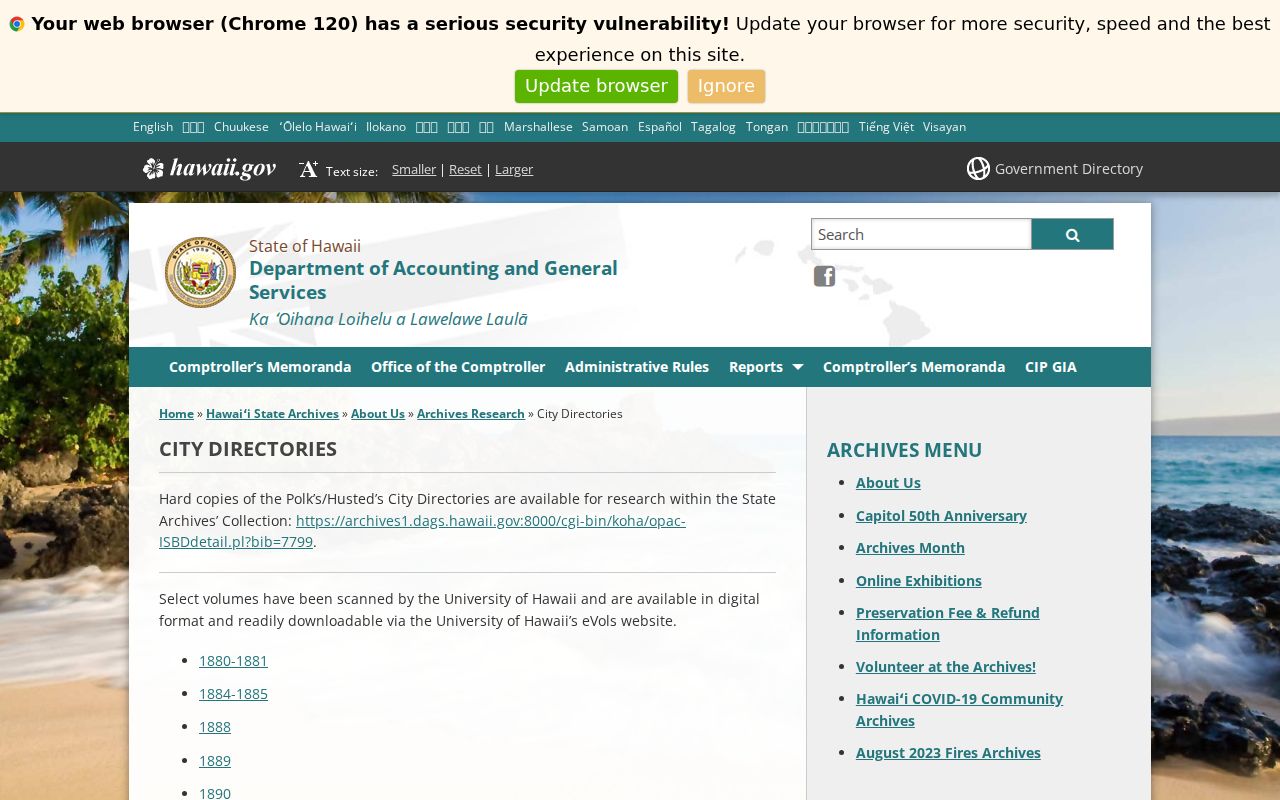
The archives list is a shelf map, not a Pearl City name search. Open the relevant countywide volume and use its own index and street guide.
A 1921 Polk-Husted volume at FamilySearch contains 1,473 pages and provides a strong sample for entry conventions. The later 1965–66 volume supplies another address-continuity point. Always keep the owning institution, catalog title, image page, and directory year with a screenshot or transcript.
Pearl City Library to Archives
Pearl City Public Library, at 1138 Waimano Home Road, offers computers, newspapers, copying, Wi-Fi, and access to genealogy tools. Ancestry Library Edition is available in a branch, while HeritageQuest is available with a library card. These databases can locate a book or census lead, but the original page still needs to be saved and checked.
The deeper shelf is the Hawaii State Library’s Hawaiʻi and Pacific Section at 478 South King Street, phone 808-586-3500. Its genealogical resources guide covers directories, obituary indexes, vital indexes, yearbooks, cemetery sources, Blue Books, Thrum’s Hawaiian Annual, Men of Hawaii, and Women of Hawaii. Reference call numbers may require staff retrieval.
Hawaiʻi State Archives, 364 South King Street, has weekday research hours from 9 a.m. to 4 p.m. Researchers register, request items by 3:30, and generally use microfilm where available. In January 2026 the archives announced sixty-four digitized index volumes covering genealogy, land, court, and cemetery records. The index is free, but an archivist or visit may still be needed for the record itself.
See the HSPLS genealogy access page for current database conditions.
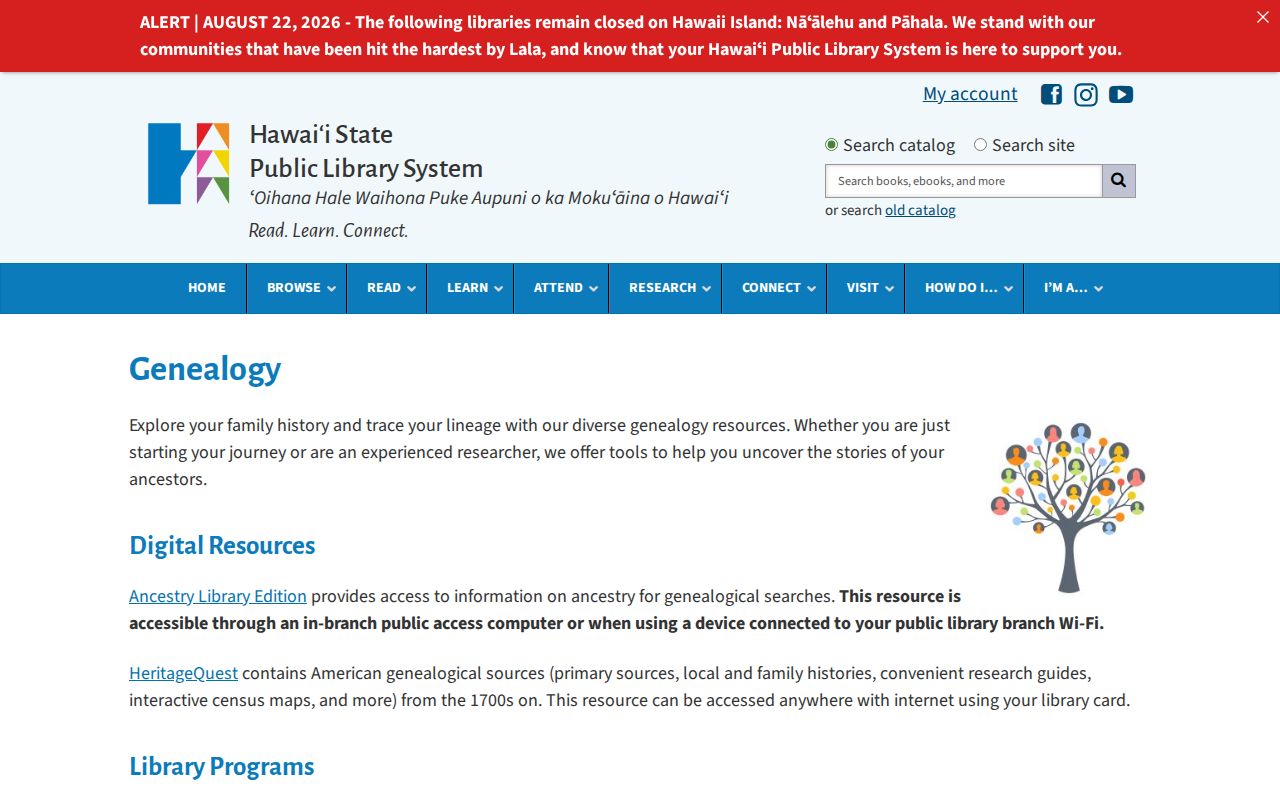
The library source adds census and newspaper tools that help test a name found in an older Pearl City volume.
Bridge Pearl City Directory Gaps
The public-library guide explicitly lists no printed directories for 1943 through 1946, 1950, and 1952. These gaps are a documented quirk. Do not carry a 1942 address forward or copy a 1951 household into 1952. Search the nearest available volumes and mark the missing year as unknown.
Newspaper and census sources provide dated bridges. The Honolulu Advertiser and Star-Bulletin print index spans 1929–1994, the Hawaii Newspaper Index begins in 1989, and the Bob Krauss index covers English-language newspaper references from 1840–1944. The obituary microfilm index covers 1836–1950. Federal census schedules for 1900 through 1950 are available under the federal seventy-two-year release rule.
Search a street, business, cemetery, school, or club with the name. A newspaper mention can show an event or role without proving a home address. Census geography also differs from the modern Pearl City CDP, so retain the enumeration district and street data rather than forcing a present boundary onto the household.
Reverse Pearl City Streets in Print
No official source identified an independent Pearl City reverse or criss-cross collection. The verified method uses the street-and-avenue guide inside the Honolulu directory. Find the street, list the visible names and businesses for the target number or segment, then verify each item in the personal-name or classified section.
A historic address may not match a modern number. Compare the directory street guide to the 1890 subdivision map, 1922 and 1928 sources, 1952 aerial, 1959 map, or 1970 highway record supplied by the local plan and H-1 study. No formal renumbering year was found. A modern TMK, plat, or legal description is a safer bridge than assuming the street retained its number.
For current address-keyed parcel and deed work, the Pearl City street directory owns the full workflow. Historical volumes should stay focused on what the publisher recorded in a specific year.
Trace Pearl City Families by Year
Historical volumes work best as a sequence. One entry is a dated clue. Several books, paired with independent records, can show continuity or a change that deserves research.
- Begin with an exact street and number from a deed, obituary, family paper, school item, or parcel record.
- Search the same name in 1898/99, 1900/01, selected Polk years, 1921, 1924, 1933/37, 1940/41, 1947–49, 1951/53, 1960, 1965/66, and later available books.
- Record changes in spouse, widow mark, occupation, number, suffix, spelling, publisher, and page. Do not smooth out differences.
- Use the street guide in reverse, then compare the closest federal census year. Check household relations, age, birth place, work, street, and enumeration area.
- Test the identity with a deed, TMK, newspaper notice, cemetery permit, probate file, or vital index. A missing directory line is not proof that a person left.
The Pearl City and Loch View Cemetery finding aid offers a highly local endpoint. Its records cover 1901–1937 and point researchers toward maps, land ownership, newspapers, and directory years such as 1912, 1921, 1929, 1935, 1940, and 1951. Search both cemetery names because “Loch View” was used during part of its history.
This pairing supports family history, heir research, and attempts to reconnect with former community members. It does not turn an old entry into a statement about someone’s present address.